
Since 2015
Custom battery pack projects
5,000 m²
Own factory
6 engineers
15+ years’ professional experience
60
Production-line employees
25+ countries
Traded with customers in
Is an 18650 Battery Pack the Right Choice for Your Device?
The 18650 is a cylindrical lithium-ion cell, 18 mm in diameter and 65 mm long, and one of the most widely produced cell formats. That gives pack designers a broad choice of cell models. Whether it is the right base for your 18650 lithium-ion battery pack depends on space, energy and current – not on habit.
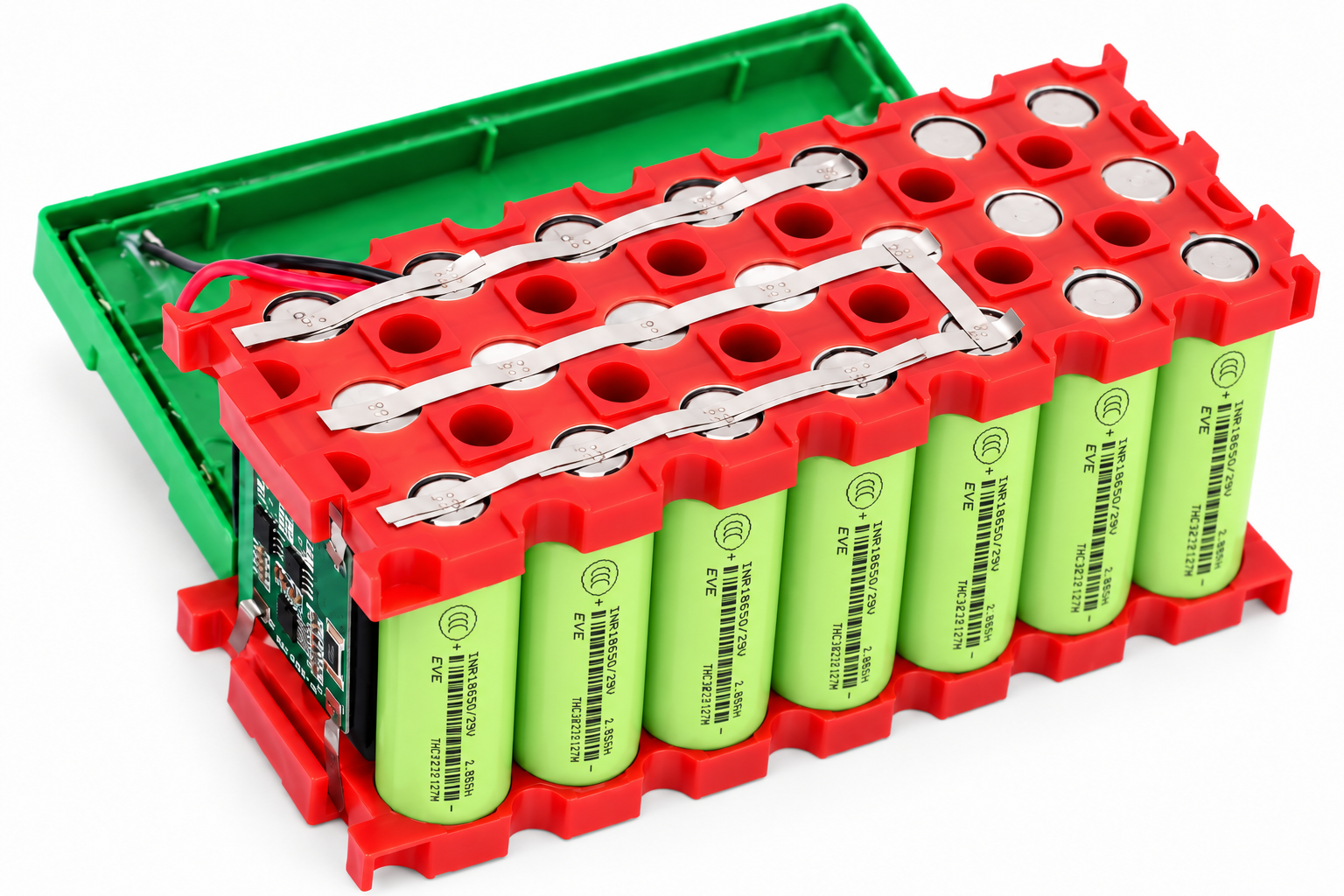
18650 usually fits when…
Look at 21700 when…
Compare both formats in 18650 vs 21700, or see custom 21700 battery packs.
Capacity-type or power-type 18650 cells?
Within the 18650 format, cells are optimised in different directions. Choosing the cell type early avoids a pack that meets its capacity on paper but sags under your real load.
|
18650 cell type
|
Optimised for
|
Trade-off
|
Typical fit
|
|---|---|---|---|
|
Capacity-type |
Highest capacity per cell and runtime per volume |
Lower continuous and pulse current rating |
Instruments, monitoring units, low-to-moderate loads |
|
Power-type (high-drain) |
High continuous and pulse current with less voltage sag |
Lower capacity per cell |
Motors, pumps and other high-current loads |
|
Balanced |
A middle ground between capacity and current |
Neither the longest runtime nor the highest current |
General portable equipment |
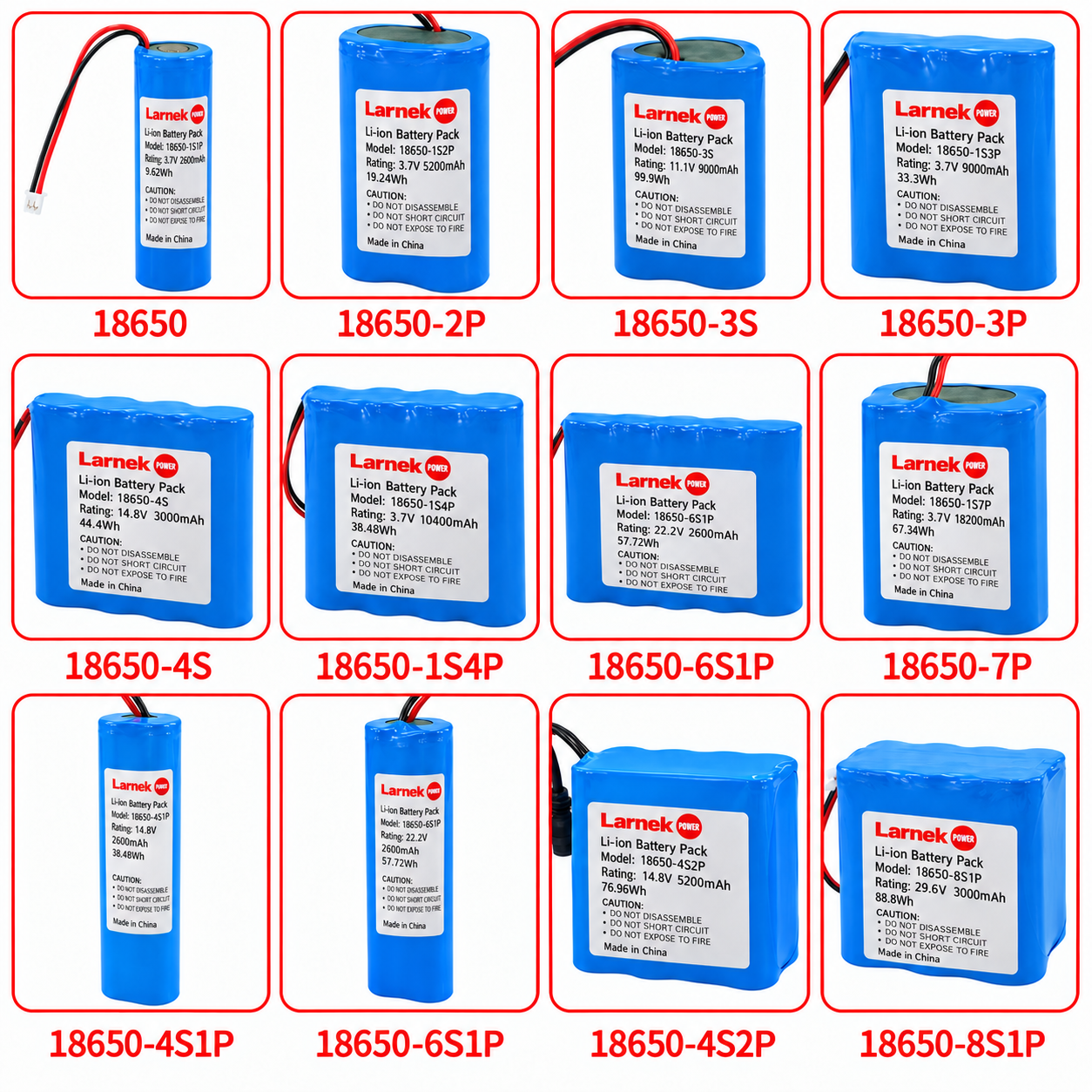
18650 Battery Pack Configurations: Voltage, Capacity and Layout
An 18650 battery pack configuration is written as xSyP: x cells in series set the voltage; y cells in parallel set the capacity and share the current. A 3S2P pack, for example, uses six cells – three series groups of two cells each.
How to calculate an 18650 pack’s voltage, capacity and energy
Nominal voltage: S × cell nominal voltage (typically 3.6–3.7 V)
Full-charge voltage: S × 4.2 V (standard Li-ion cells – check the datasheet)
Rated capacity: P × cell capacity (mAh or Ah)
Energy: Nominal voltage × capacity (Ah) = Wh
Cell count: S × P
Worked example: 4S1P with 3,000 mAh Cells
Actual usable capacity and runtime depend on discharge current, temperature, BMS settings, cut-off voltage and the operating conditions of the device.
Common 18650 pack voltage classes
|
Series count
|
Nominal voltage*
|
Full-charge voltage
|
Often specified as
|
Cells in a 2P build
|
|---|---|---|---|---|
|
1S |
3.6–3.7 V |
4.2 V |
3.7 V pack |
2 |
|
2S |
7.2–7.4 V |
8.4 V |
7.4 V pack |
4 |
|
3S |
10.8–11.1 V |
12.6 V |
11.1 V or “12 V” pack |
6 |
|
4S |
14.4–14.8 V |
16.8 V |
14.4 V / 14.8 V pack |
8 |
|
6S |
21.6–22.2 V |
25.2 V |
22.2 V pack |
12 |
|
7S |
25.2–25.9 V |
29.4 V |
“24 V” pack |
14 |
* Reference values for 3.6–3.7 V nominal lithium-ion 18650 cells. “12 V” and “24 V” are labels: a 3S pack runs from 12.6 V when full down to its cut-off voltage, so we check that whole range against your device’s input window. Other series and parallel counts are reviewed per project for current, thermal and safety design.
Same cells, different pack
A 4S2P and a 2S4P pack both use eight cells and store the same energy. One delivers twice the voltage; the other twice the capacity and current capability. Your device’s voltage window decides which is correct – which is why we ask for the minimum and maximum input voltage, not just a nominal figure.
Fitting an 18650 Battery Pack Into Your Housing
Cell count fixes the electrical design; the layout decides whether the pack fits. With 18650 cells the same configuration can be arranged in several ways. In a straight row each extra cell adds about 18 mm side by side, or 65 mm end to end – before holders, insulation and the BMS.
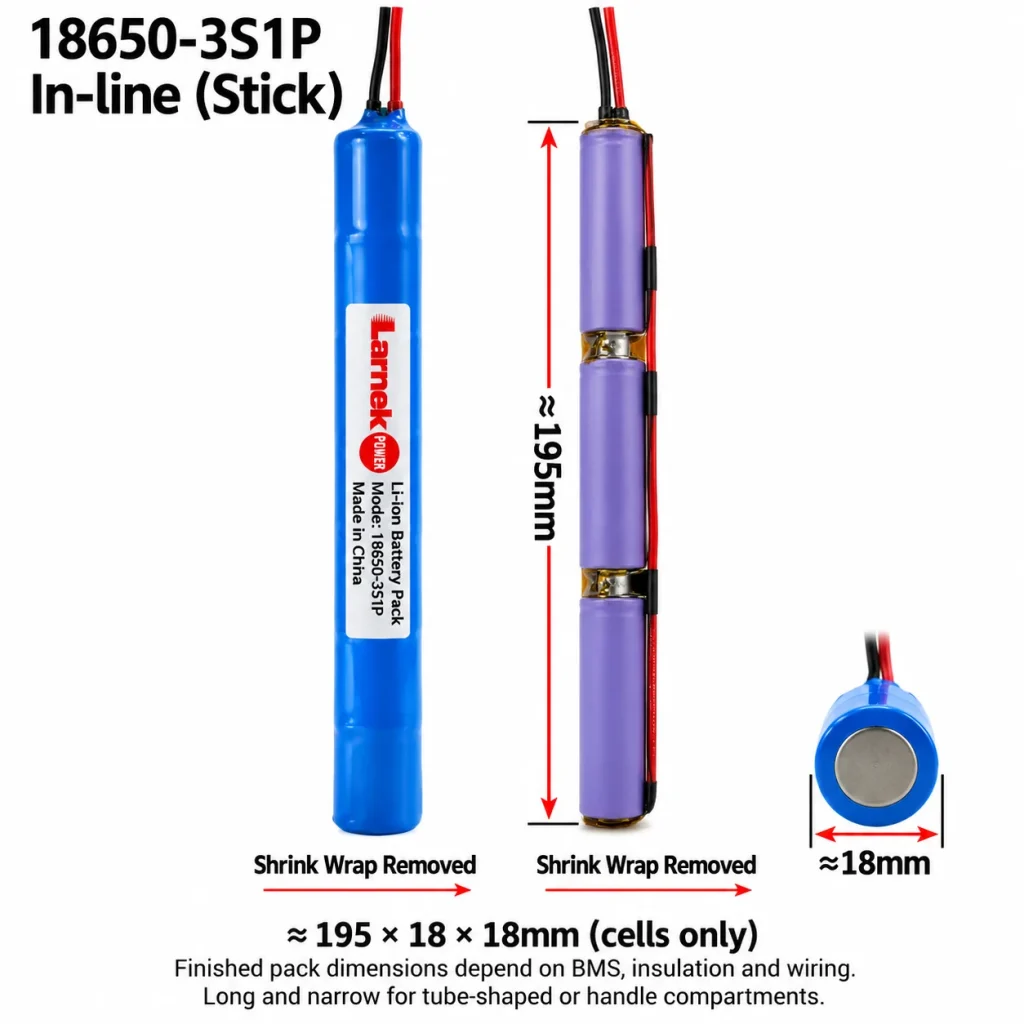
≈ 195 × 18 × 18 mm (cells only)
3S1P · in-line (stick) – long and narrow, for tube-shaped or handle compartments.
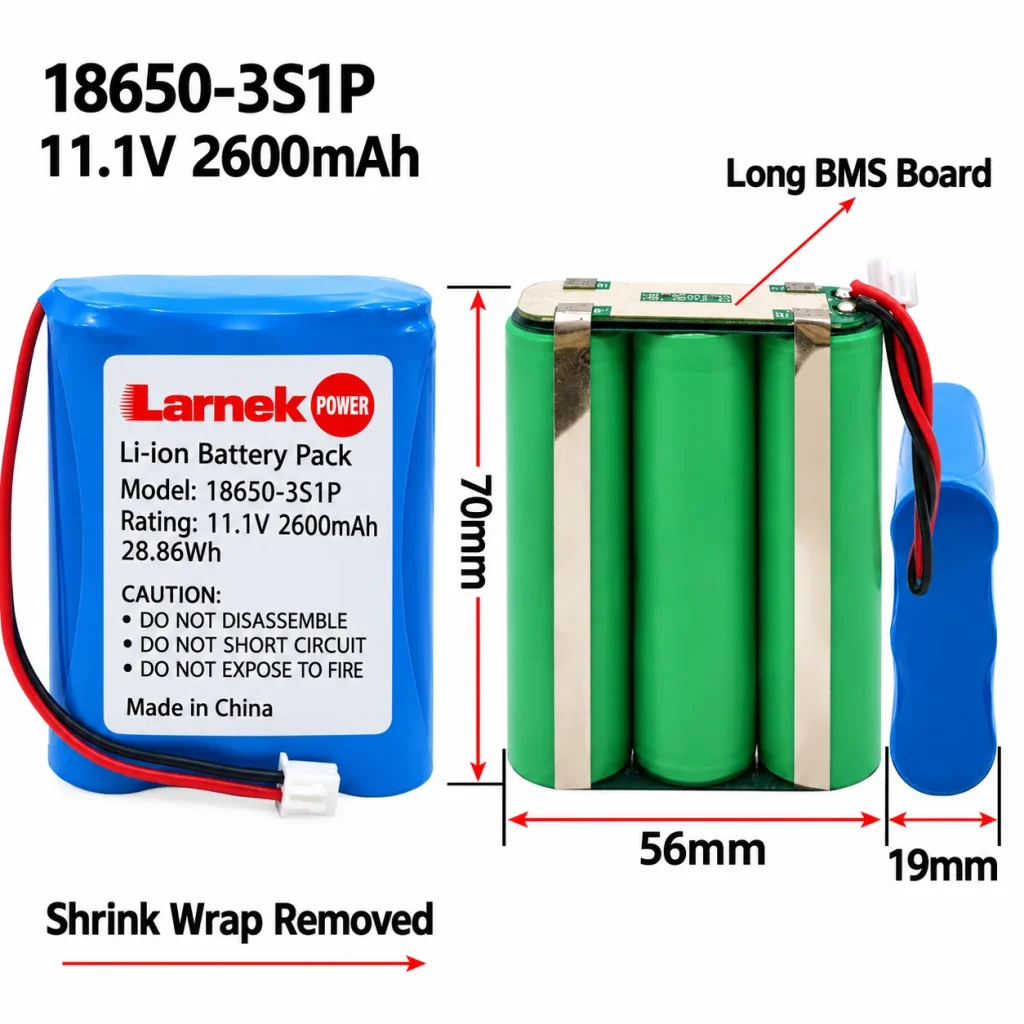
56 × 19 × 70 mm · 11.1 V 2600 mAh
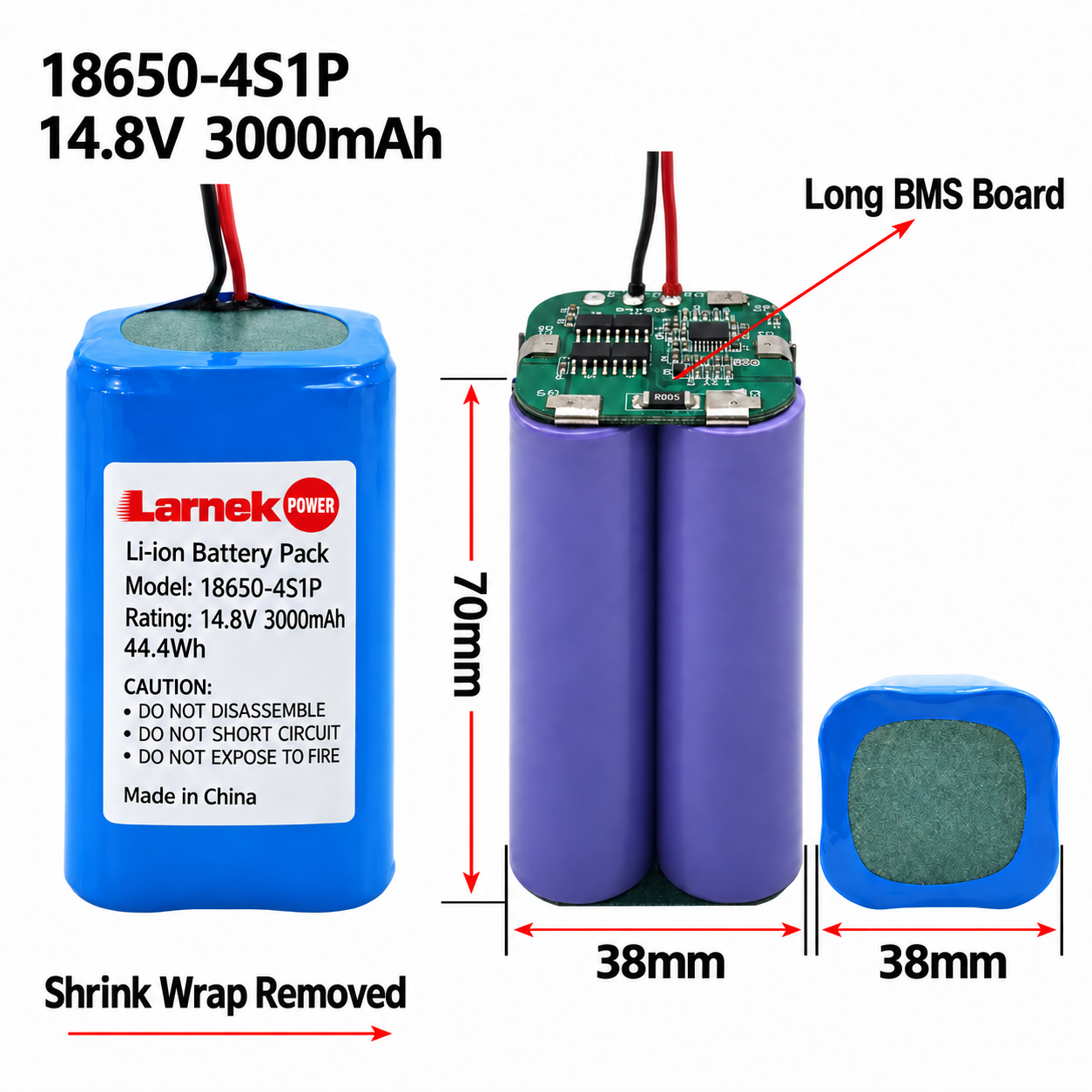
3S1P · flat – the same three cells side by side as a short, flat pack, with a long BMS board along the top.
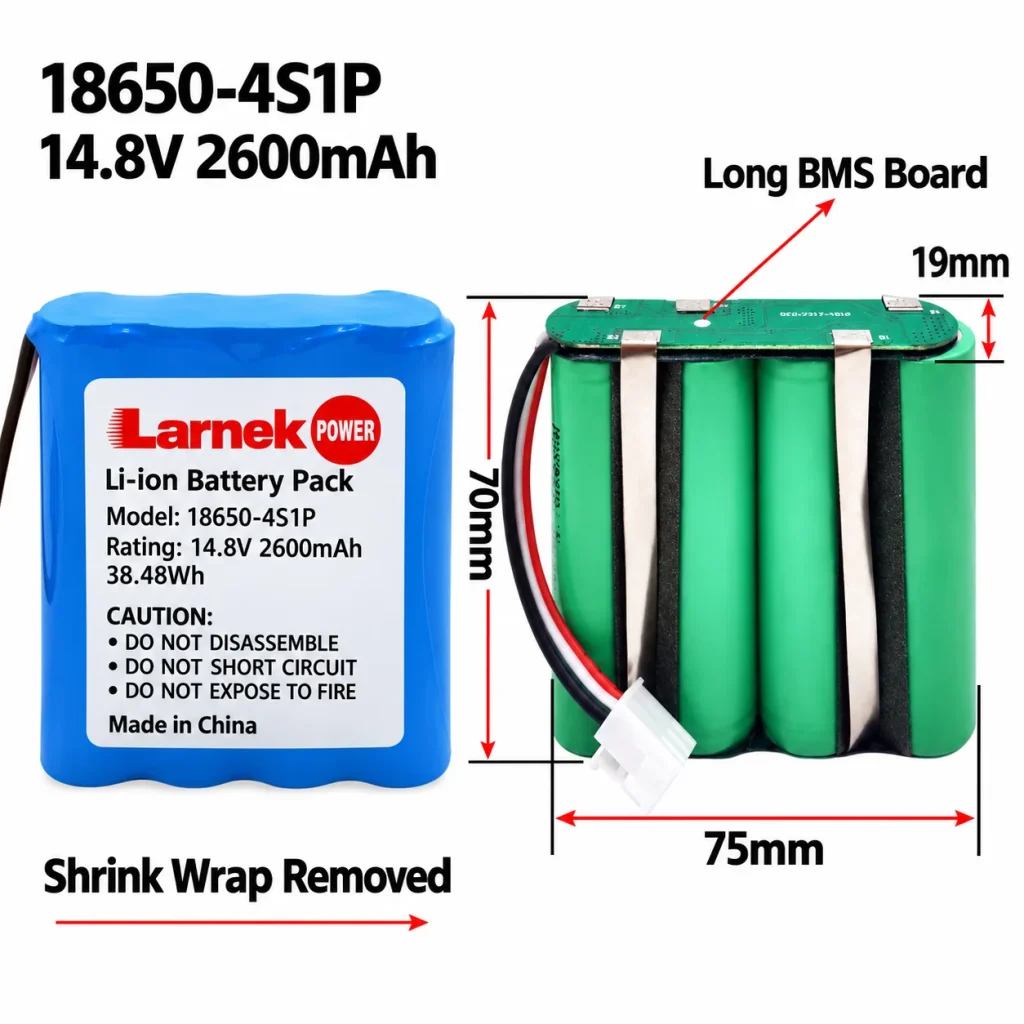
75 × 19 × 70 mm · 14.8 V 2600 mAh
4S1P · flat – one more cell in the row adds about 19 mm of width and one series step in voltage.
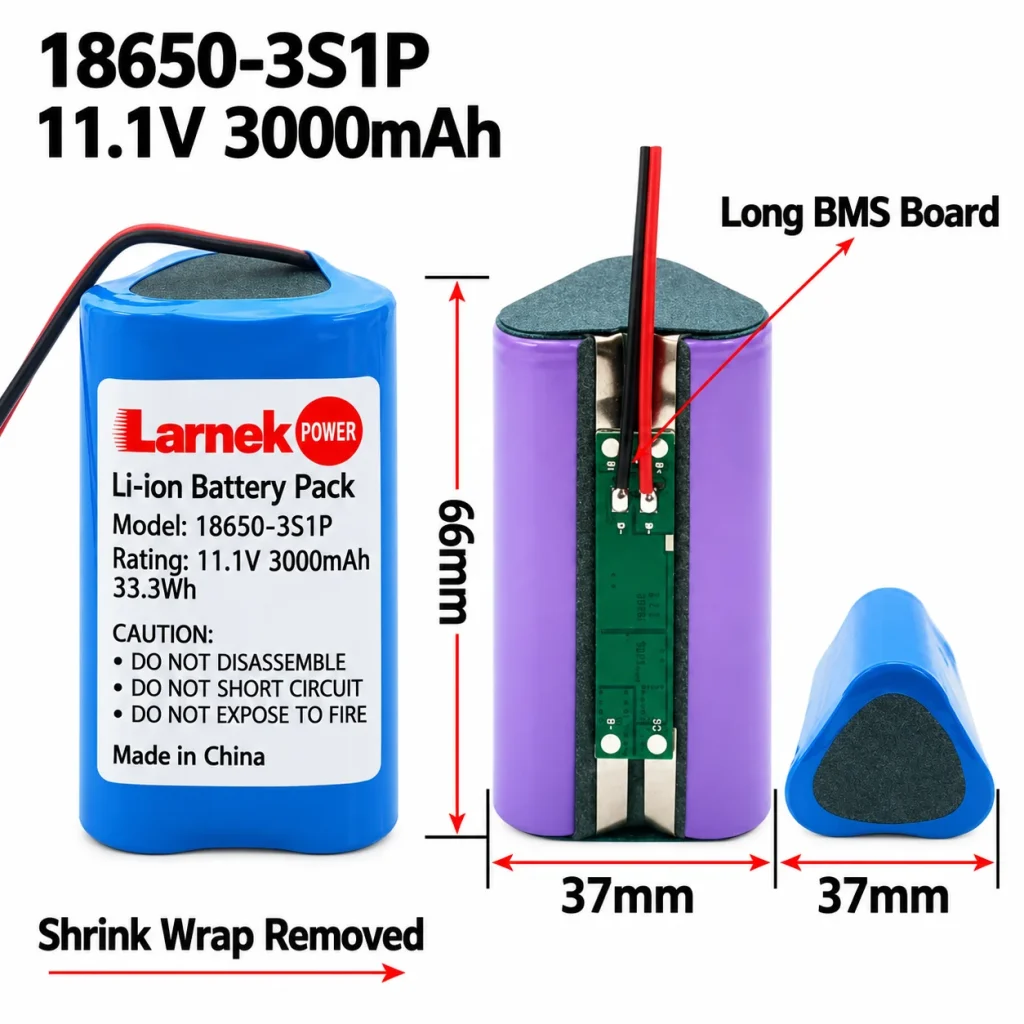
37 × 37 × 66 mm · 11.1 V 3000 mAh
3S1P · triangle – three cells stacked in a triangle for a compact section in deeper housings.
What adds to the envelope beyond the cells
What helps us lay out your 18650 pack
Pack structure and assembly are covered in more detail under battery pack design and assembly.
BMS, Connectors and Pack Format for 18650 Packs
The cells set what a pack can deliver; the BMS, harness and pack format decide how safely and simply it works inside your device.
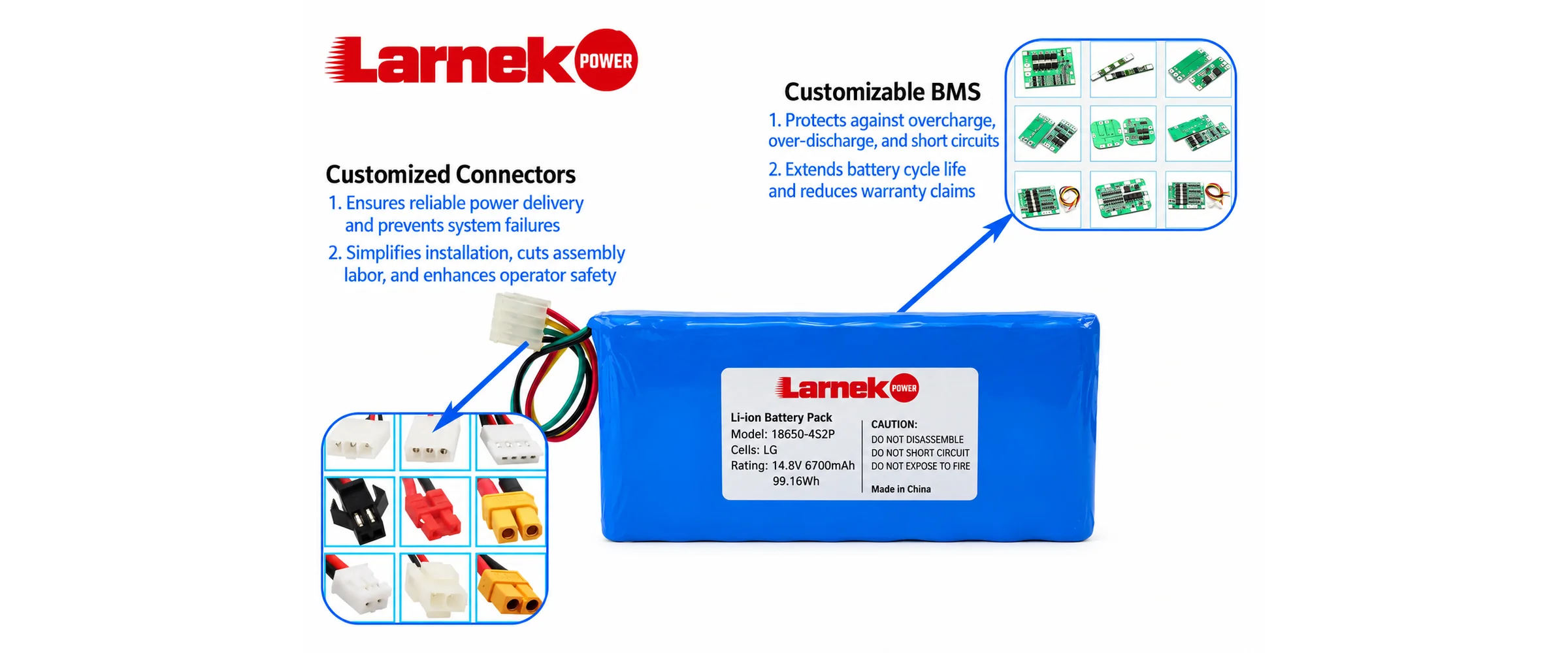
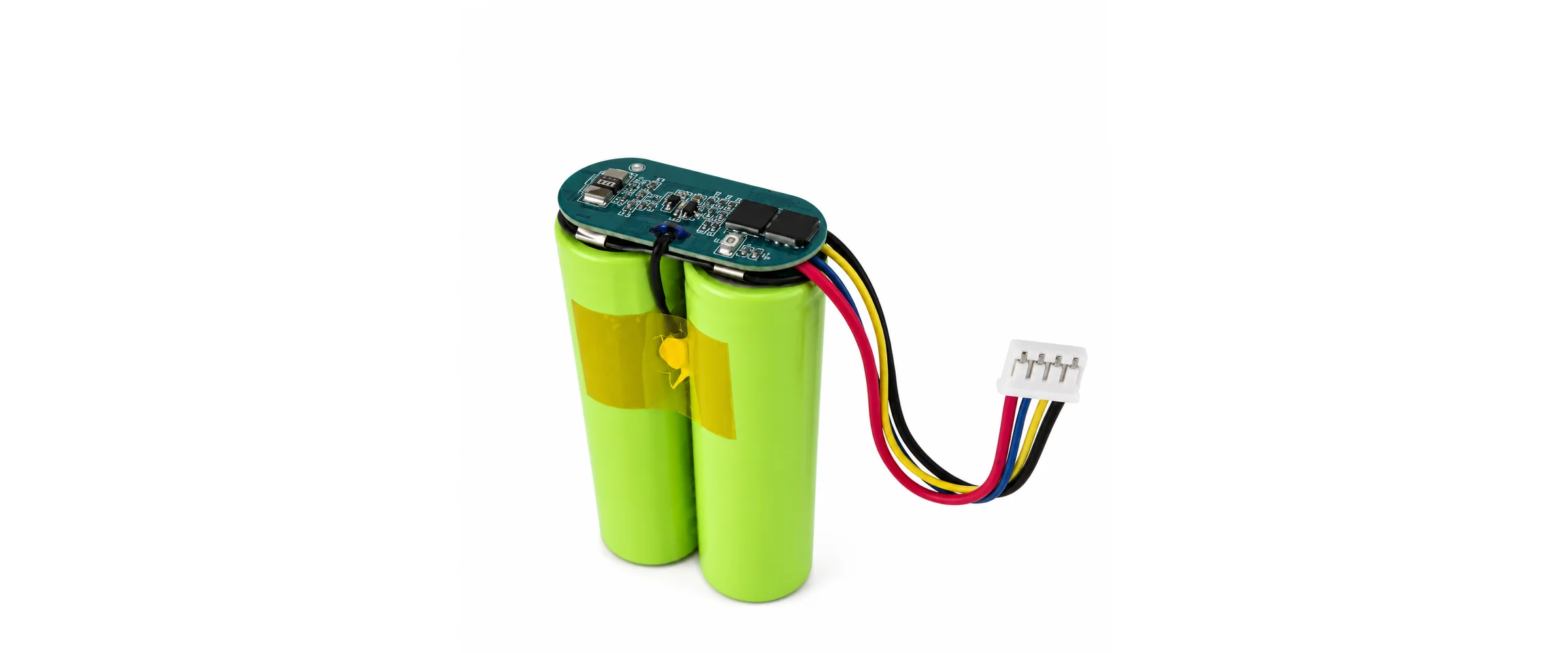
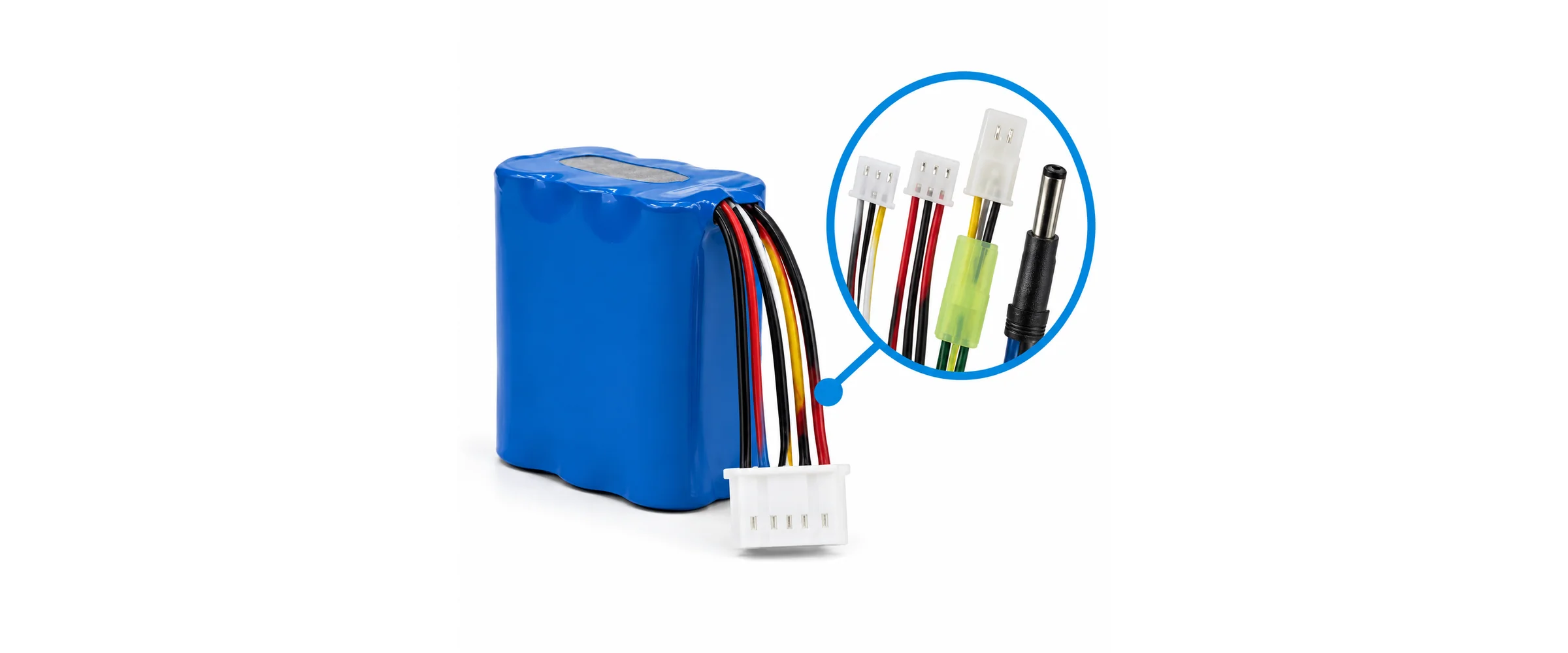
BMS & protection
An 18650 battery pack with BMS protection is matched to its series count and to your continuous and peak current. Protection typically covers over-charge, over-discharge, over-current, short circuit and temperature. Packs with several cells in series also need balancing to keep the series groups aligned over the pack’s life.
BMS integration
Connectors & wiring harness
We specify the connector, wire gauge, lead length and pin-out against your device’s mating connector and current, so the pack installs without adapters. Tell us whether charge and discharge share one port, and whether your device expects a temperature-sensor line or battery data from the pack.
Pack format
The format follows how your device carries the battery – from an insulated, wrapped cell block for an enclosed compartment to a pack in a protective housing where it is handled or exposed. Mounting method, vibration and operating temperature all feed into this choice.
Where Custom 18650 Battery Packs Are Used
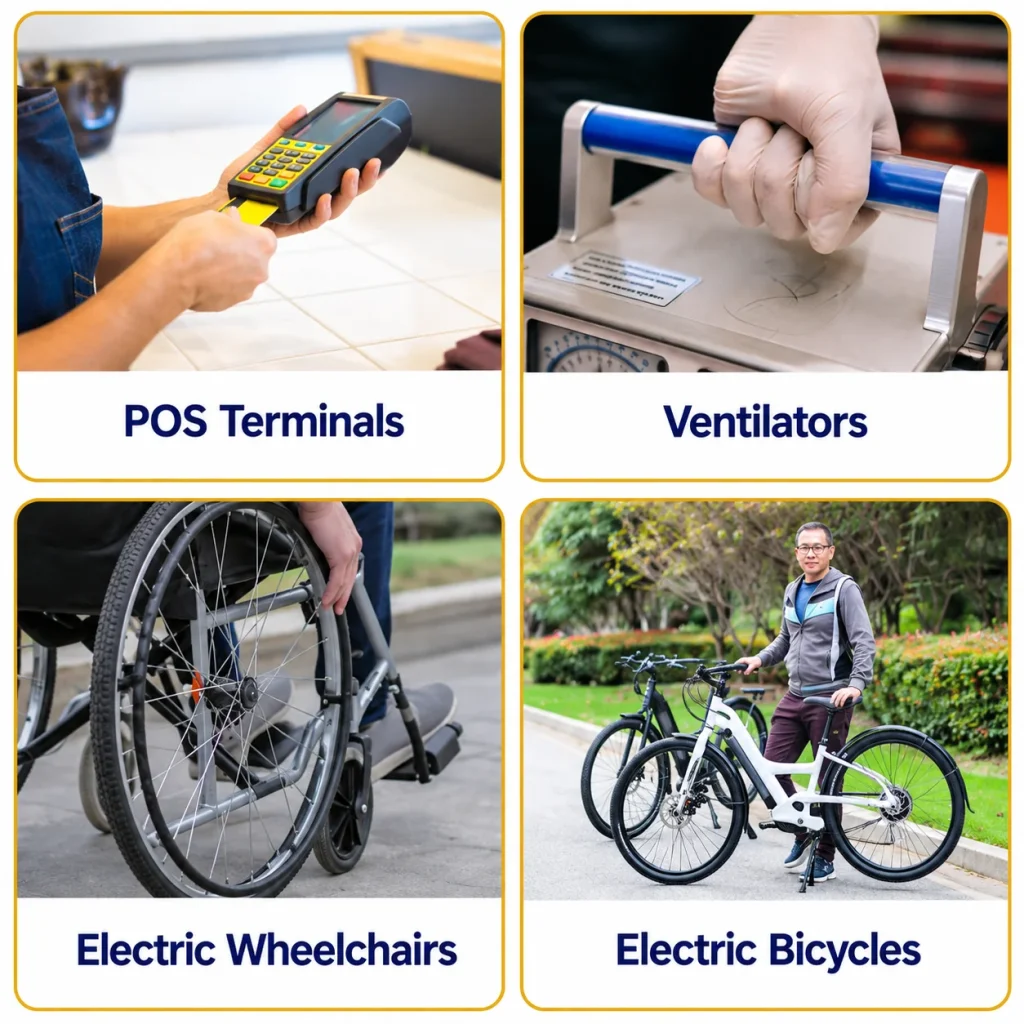
The design priority changes with the equipment. These are the questions that usually shape an 18650 pack in each of our focus applications.


|
Application
|
Main design driver
|
What we check in the 18650 design
|
|---|---|---|
|
Portable instruments |
Size and weight |
Layout options; capacity-type cells against the runtime target |
|
Inspection & measurement devices |
Stable supply through the whole run |
Device minimum voltage against pack cut-off; series count |
|
Communication equipment |
Transmit pulses |
Cell pulse-current rating, parallel count and voltage sag |
|
Remote monitoring systems |
Long intervals between service visits |
Self-discharge, site temperature range and capacity margin |
|
Emergency lighting |
Standby duty |
The luminaire’s charging method and the temperature inside the fitting |
|
Cleaning equipment |
Motor and pump load |
Continuous current, cell type and thermal layout |
|
Portable power equipment |
Energy against carrying weight |
Wh per kg trade-off and output current |
|
Industrial equipment |
Integration and repeat supply |
Mounting, vibration and connector – see industrial battery packs |
Equipment not listed? Describe it in your RFQ, or browse applications.
From 18650 Pack Sample to Volume Supply
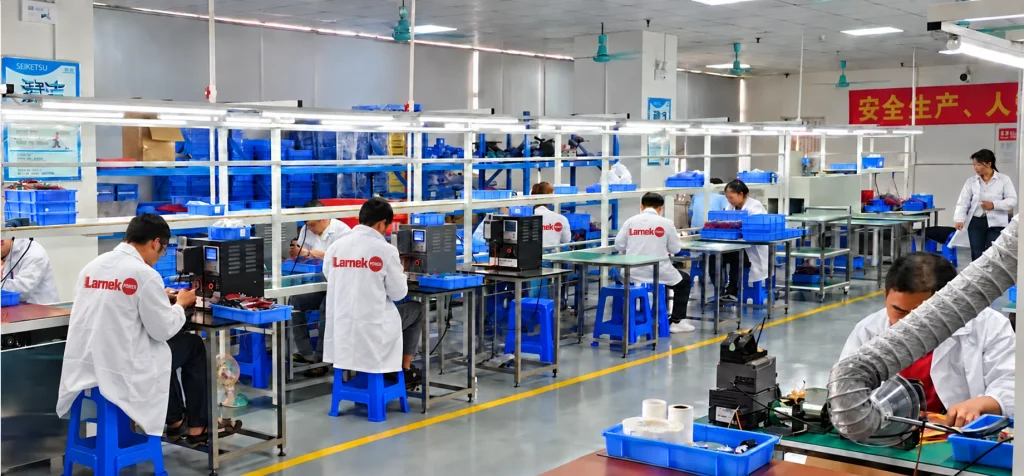
Your 18650 pack follows the same route as every Larnek project: requirement analysis, cell selection, electrical and structural design, BMS integration, samples, testing and volume production. The step-by-step version is on our OEM & ODM battery pack development page. For 18650 packs, three points matter most:
Configuration agreed before samples
The proposed cell, xSyP configuration, layout and BMS are shared for your review before any sample is built.
Samples tested in your device
Prototype packs are checked for fit and function in your own product, then verified against the agreed specification.
Consistent repeat builds
The approved cell, configuration and BMS become the build specification for volume production.
Test reports and transport documents depend on the pack and the target market – pack energy in Wh is one of the inputs. We confirm which apply at quotation; see testing, certification and compliance.
Since 2015 · own factory of 5,000 m² · 6 engineers with 15+ years’ experience · 60 production-line employees · customers in 25+ countries. Learn more about Larnek Power as a custom battery pack manufacturer.
18650 Battery Pack FAQs
Your Battery Pack, Built Safe, Compliant and On Time
Backed by a strong Shenzhen supply chain, a dedicated engineering team and hands-on export experience, Larnek Power helps OEM teams move custom battery packs into production with consistent quality, competitive cost and the paperwork export requires.
Tell Us About Your Battery Project
Larnek Power supports OEM and industrial customers with custom 18650 and 21700 lithium-ion battery packs, from initial requirements and prototyping through volume production.
Tell us about your application, target voltage and capacity, size limits, current requirements, estimated quantity, and any drawings or existing battery details. Our engineering team will review your requirements and help define the next steps for your project.